Island
The quietest Greek islands, measured
Written by Elena Philippou, who hosts Villa Olivia Clara above Platis Gialos.Updated August 2026
Every guide to quiet Greek islands tells you it is quiet and leaves you to take their word for it. Here are two numbers you can look up yourself. How many people live on the island, and whether it has an airport. On the western Cyclades ferry line out of Piraeus, seven of the nine islands have no airport, and the largest of those seven is Sifnos, with 2,777 residents.
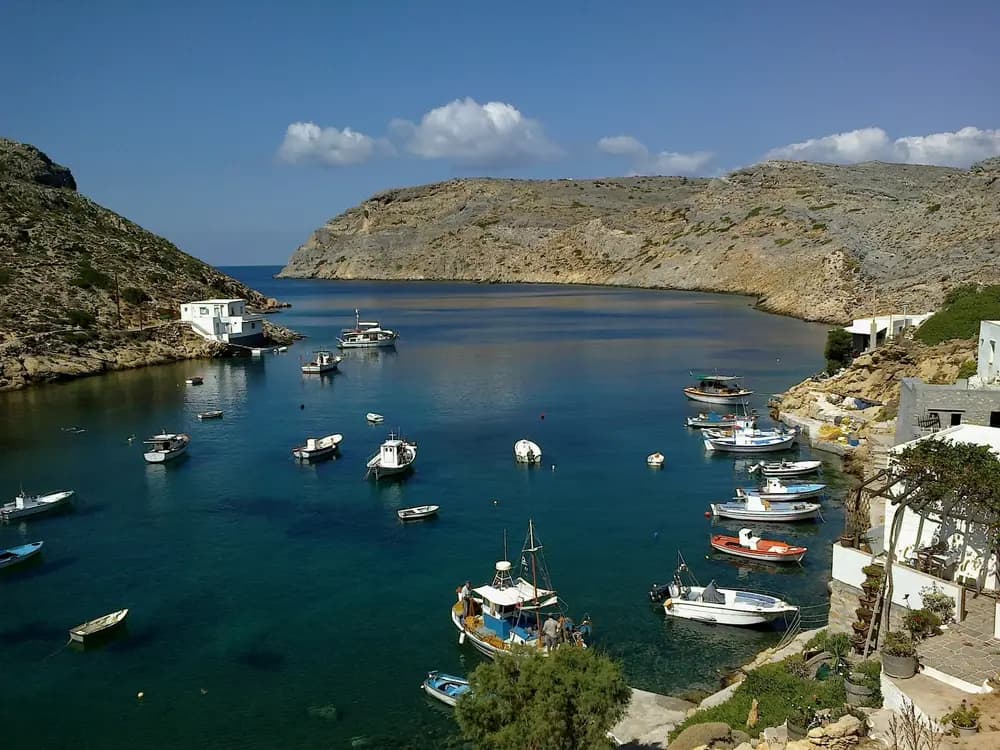
The airport is the line that matters. An island with a runway takes charter flights, connecting passengers and day arrivals that never show up in a ferry timetable. Milos and Santorini sit on this same route and feel nothing like the islands between them.
Below is the whole line, in sailing order, with the 2021 census behind every figure. No shortlist and no favourites. The two islands that beat Sifnos on size are in the table too.
The short answers
- Which island here is the emptiest?
- Sikinos, by a wide margin, on population and on residents per square kilometre. It is also the hardest to fill a week on, and nobody mentions that part.
- Which is quiet without being empty?
- Sifnos. It carries the most residents of any island on this line without an airport, at 2,777, and outside Santorini it is the densest island on the route. Enough of us live here year-round to keep the villages open, the bus running and the kitchens going when the season ends.
- Which of these islands have an airport?
- Milos and Santorini, and that is the whole list. The other seven you reach by ferry, which caps how many people can arrive on any given day.
- Does quiet mean hard to reach?
- Not on this line. Every island here is a direct sailing from Piraeus and the ferry calls in order, so none of the quiet ones is a detour. They are stops on the way to Santorini.
The whole line, in numbers
Nine islands, in the order the ferry calls at them leaving Piraeus, with population from the 2021 Greek census at municipality level, read out of the statistical authority's own workbook. Land area comes from the published municipality figures, because the workbook does not carry it. Density we worked out from those two columns. Hotel beds are the 2025 count from the Greek hotel register, and beds per resident we worked out from that and the census.
Western Cyclades ferry line, in sailing order
| Island | Residents | km² | Per km² | Hotel beds | Beds per resident | Airport |
|---|---|---|---|---|---|---|
| Kythnos | 1,568 | 100.2 | 15.6 | 241 | 0.15 | None |
| Serifos | 1,241 | 75.2 | 16.5 | 314 | 0.25 | None |
| Sifnos | 2,777 | 73.9 | 37.6 | 1,103 | 0.40 | None |
| Kimolos | 810 | 36.0 | 22.5 | 118 | 0.15 | None |
| Milos | 5,302 | 160.1 | 33.1 | 1,590 | 0.30 | Milos Island National Airport (MLO) |
| Folegandros | 719 | 32.2 | 22.3 | 1,107 | 1.54 | None |
| Sikinos | 253 | 42.5 | 6.0 | 37 | 0.15 | None |
| Ios | 2,299 | 109.0 | 21.1 | 2,341 | 1.02 | None |
| Santorini | 15,480 | 90.7 | 170.7 | 18,367 | 1.19 | Santorini (Thira) Island National Airport (JTR) |
Population from Hellenic Statistical Authority, 2021 Population-Housing Census (resident population by municipality, 2024 revision), read first-hand from its published workbook. Land area from the published municipality figures, which that workbook does not carry. We checked all nine rows against the workbook on 2026-08-23.
Hotel beds are the 2025 figures from Hellenic Chamber of Hotels / ITEP, hotel capacity of Greece 2025, by region, prefecture and island. They count licensed hotels only, so rooms-to-let and holiday rentals fall outside them on every island here. Three of the totals that document prints disagree with its own star-rating columns, and we have used the star columns, which add up to the regional totals printed in the same document.
Why the runway decides it
2 of these nine islands have an airport. It is the strongest single predictor of how an island feels in August, and it beats any adjective, because you can look it up.
A ferry has a fixed capacity and a fixed timetable. An island reached only by ferry can absorb at most the number of people its sailings carry that day. And everyone who arrives has already given up four or five hours to get there, which does most of the filtering.
Add a runway and the arithmetic changes. Flights land several times a day in season, connect through Athens in under an hour, and open the island to people who would never have given up a morning to a boat.
The harbourmaster on Sifnos counts every arrival, which makes it the one island on this line where the claim can be tested against a number instead of taken on trust. In 2025 that number was 167,676. August alone brought 44,924, against 2,777 residents. With no runway, the ferry is the only way in, so nobody arrives uncounted.
The arrivals are counted by Λιμενικός Σταθμός Σίφνου, the island's port authority, and published by Δήμος Σίφνου, the municipality. They count passenger movements off ferries, which include residents coming home and day trips, so they are not a count of visitors. The series starts in 2018 and skips 2020 and 2021, which the source leaves out.
More beds than people
Folegandros carries 1.54 hotel beds for every resident. That is 1,107 beds against 719 people, the highest ratio anywhere on the line.
3 of these islands hold more tourist beds than residents. Santorini is one of them, at 1.19 beds a head. The other is the island travel writers keep recommending as the quiet alternative to Santorini.
Sifnos sits at 0.40. That is 1,103 licensed hotel beds on an island with more than twice the land of Folegandros and nearly four times the residents.
One caveat, said plainly. These are licensed hotel beds. Rooms-to-let and holiday rentals sit outside the hotel register, and on small Greek islands they carry a large share of the supply. That undercount falls on all nine islands the same way, so the ratio still compares even where the absolute numbers run low.
Quiet, or too quiet?
Calm and empty are different islands. Most people asking which island is quiet mean the first one. Here is where each of the nine falls.
- Kythnos
- The first call out of Piraeus and the closest of these to Athens. Fewer than 1,600 residents across a hundred square kilometres, which is a lot of empty ground per person.
- Serifos
- Fewer residents than Sifnos on slightly more land. One striking hilltop chora above the port, and the chora is the reason to go.
- Sifnos
- The most residents of any island on this line without an airport, and the densest on the whole route except Santorini. Quiet by arrivals, and full of people who live here all year.
- Kimolos
- Small, low, and most people reach it via Milos. It is named in almost every least-touristy list now, which is doing it no favours.
- Milos
- The airport changes it. Largest island on the route short of Santorini, and the only one before Santorini where people arrive by air.
- Folegandros
- Under a thousand residents and a chora on a cliff that does most of the island's marketing. Small, and a few days is about the size of it.
- Sikinos
- The emptiest island on this line by a distance, on both measures. Beautiful, and hard work for a full week.
- Ios
- The outlier. Quiet by resident population, and famous for its nightlife, so the numbers mislead here more than anywhere else on the list.
- Santorini
- The terminus, and by population density several times anything else on the route. It is on this table as the control.
What the numbers do not tell you
Resident population is a proxy. It tells you how much island there is underneath the season. How many kitchens stay open in May, whether the bus runs, whether the village has a butcher. It will not tell you how many people are on the beach in the second week of August.
Nobody publishes per-island August arrivals at a granularity worth quoting, so this page does not quote them. Where we could not check a figure, we left it out.
Common questions
- Which Greek island is the least touristy?
- On the western Cyclades line, Sikinos, on resident population and on density. Across the whole of Greece, dozens of small islands compete for the title, and the ones that get named in articles stop qualifying soon afterwards.
- Which Greek islands have no airport?
- On this ferry line, 7 of the nine. Kythnos, Serifos, Sifnos, Kimolos, Folegandros, Sikinos and Ios, which leaves the runways to Milos and Santorini.
- Is Sifnos quiet?
- By the measures on this page, yes. No airport, so every arrival comes by sea. It is also the largest island on the line without one, at 2,777 residents, so it is the least empty of the quiet ones.
- Which Greek island is quiet but not too quiet?
- Sifnos, on this line. Enough residents to keep the villages, the buses and the tavernas running outside the season, and no runway to raise the ceiling on how many people can arrive in a day.
- Are the quiet islands harder to get to?
- They take longer, and that is all. Every island in this table is a direct ferry from Piraeus on the same line, and the quiet ones are earlier stops than the busy ones.
- When are these islands quietest?
- Outside the July and August peak on all of them. Late May, June and September carry the fewest arrivals while the ferries are still running a full summer timetable.
The house behind this page
Villa Olivia Clara sits above Platis Gialos on Sifnos, sleeps eight and has its own pool. We host it ourselves, and these are the numbers we would want if we were the ones choosing.
See the villa